the mid-year financial reset
recovery period after three long months of spending habits driven by impulse and a lack of guardrails



There’s a ring on my finger, the incessant “when’s the wedding?” buzz in my ear, and $3,000 depleted from my bank account on frivolities. Frankly, this is the moment where my financial anxiety has reached its peak. With an impending (I promise I’m excited about this) wedding to fund and the desire to set our roots down by buying a home big enough to fit my fiancé’s larger than life hobbies (of which I love and support because they are my conversation starter when anyone asks about him), I need to save as much money as possible, without the over-complication of desiring upgrades, luxurious travel, and the occasional what ifs. The budget needs to be the leanest it can get, and I can no longer justify spending money for the sake of living a better life.
And at the age of 29, where my default is to scour social media pages for reviews before buying anything, I can’t say I’m necessarily regretful of previous purchases. I’m mostly satisfied the items I currently own. While some were impulsive buys, they were either items I’ve thought about for years, or had a specific purpose to fulfill a need of mine. However, my instinct is to always buy new, as someone who utilizes the return policy heavily if something feels a little off. With the thrifting/secondhand method, once I buy it, I’m forced to keep it. The flexibility of knowing that I can send back an item if it isn’t the perfect item I imagined it to be has been my biggest mental obstacle to fully embracing a frugal and sustainable life.
I’ve published a number of newsletters about spending challenges, saving money, and decreasing lifestyle inflation. However, they have all been published at distinct stages of my life, where circumstances make spending easier or more difficult, depending on the line item. As I’m on the brink of starting a new chapter of life with my fiancé, this Mid Year Financial Reset will capture the following:
Reflecting on what life looks like at the moment — joy bringers and spending triggers
Concretely establishing goals stating exact numbers and due dates
Examining my budget closely and strategically planning how I will be decreasing my cost of living
Saving tips for me (and you)

Reflecting on what life looks like at the moment — joy bringers and spending triggers
Currently writing this in July, in my two-bedroom, 1.5 bathroom apartment in Southern California, a homemade Spanish iced latte in hand. I currently exist in a standard of living greater than what I could ever dream of at this age. Our south-facing apartment receives generous light throughout the day, our rent moderately priced supplied with an in-unit washer and dryer (!), my workplace as a medium to fulfill my social battery quota among coworkers I can actually call my good friends, struck between a fine line of feeling happily complacent in life but toeing over the feeling of wanting more in my career.
Good health comes and goes — lately I’ve been experiencing waking up with some nausea and headache, more consistently than I’d (obviously) like, strong bouts of anxiety during my luteal phase, but otherwise, all with access to healthcare with a PPO health insurance plan I can’t complain about. In the context of health behaviors that I can actually control, a good diet, daily movement, and good sleep have wavered in quality. I fall more short in getting steps in as compared to eating well, as I’m still trying to figure life without following the strict rules of veganism. At times, I find myself sleeping at 2 a.m., not for any particular matter.
Many things bring me joy, including but not limited to:
✶ Decluttering on a weekly basis. My buy nothing group on Facebook and I are besties, and I don’t even have to send my pick-up spot since most of the people I gift items to are “regulars”.
✶ Our three-year old Kivik couch that I’ve arranged into the most cozy, comfortable sanctuary for naps, full sleeps, working on Substack posts (like this one), and watching TV.
✶ Following a recipe that actually ends up being good (latest obsession: spicy sweet and sour fried eggs by TiffyCooks). Too many online recipes have been looks first, taste last. I will not be making a matcha yogurt chia bowl ever again.
✶ Having a good laugh with my fiancé, who is the funniest person I know.
✶ Paycheck days, especially as someone who gets paid once a month. The financial dopamine in my brain, if that’s even a thing, runs out at the halfway mark of the month, and if I could, I would go back to the twice a month paycheck cycle.
✶ Towels that dry quickly. As a multiple wash-then-towel-dry-er when I’m doing my skincare routine at night, I find it deeply satisfying to be able to dry my hands, knowing that the hands will indeed be dry. I have long-standing beef with Piglet in Bed and had to get two bedsheets replaced due to quality issues, so you bet I was surprised when this towel (that they’re sadly discontinuing) surpasses all my absorbency-related expectations.
✶ A 2+ mile beach walk. A bonus if there are benches at the beach and I can take a break while reading a book. Truly an ideal weekend activity.
✶ A barista-worthy iced matcha latte in the morning. My current recipe is 4g high quality matcha + 40ml room temp water + 100 ml oat milk + 10-15g syrup over ice cubes. I spice things up by using different flavored syrups.

Despite most of these joy bringers being no-spend or low-cost activities, my spending triggers sometimes overcome my desire to save. When they do, the spending becomes a domino effect, and months later, I have to haul myself up by my shoulders and give me a good shake. This was how I felt in late June when I paid off a $5K credit card balance. I’ve identified a few situations where spending triggers lead to a months-long shopping spree.
✶ When I need to purchase an item for a specific event, I start to justify a slew of other items that are event-specific. A good example of this is my best friend’s wedding earlier this year; I purchased the necessity — the dress. As for the non-essential, I paid $125 to get the dress tailored and $400 for a pair of designer heels because every other lower cost heel I tried on at Nordstrom was painful and unstable. A necessitated purchase is dangerous territory because the moment I remember the feeling of putting my credit card information in and waiting for the package to arrive, I continue to chase it for as long as the irrational, budget-averse part of my brain stays active.
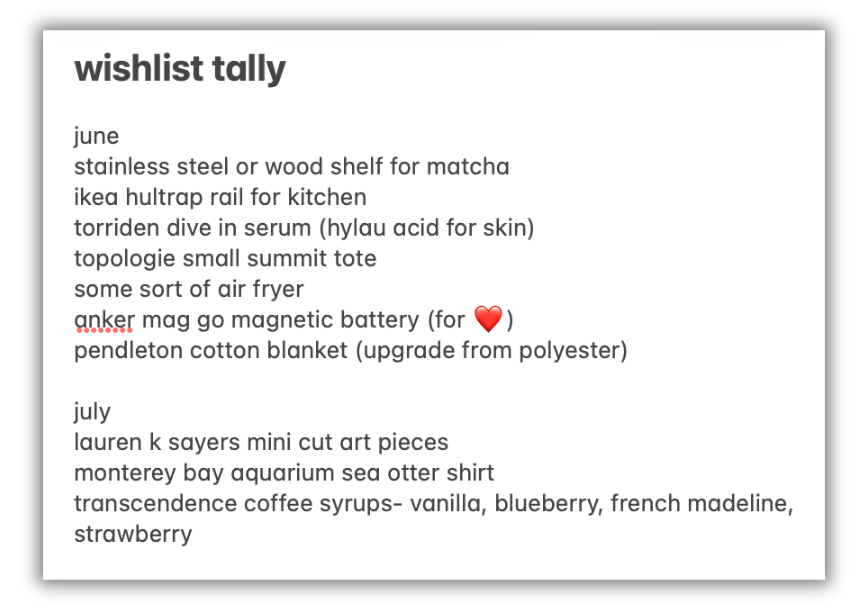
✶ Being inundated by things on things on things online. I’ve redownloaded TikTok and created a new account — it’s been good so far. Even though there are a few things that creep into the “looks cool, I kind of want it” territory, I’m able to hold back. What helps is this Apple Note where I jot down items I want. Despite my love for my Notion wishlist template, adding items in can get a bit cumbersome on mobile, so the Apple Note is my go-to right now.
✶ The urge to upgrade once I see someone with a better version of an item I own. This might be my biggest vice. I love an upgrade as much as the next person, and as a BIFL supporter, simply knowing that I could leverage a lifetime warranty or have confidence in the item’s quality typically results in me making that purchase. Unfortunately, these upgrades haven’t always been successful, as I’ve dealt with disappointing quality and performance after trying to replace what I currently own.

Concretely establishing goals stating exact numbers and due dates
My two main long-term sinking funds are for 1) our wedding and 2) a downpayment for a future home. We’d like to prioritize the wedding first, and are aiming to save $50,000. We’re shooting for $35,000, but $50,000 is for any unexpected expenses along the way. Rather than setting a date for completing the fund, we agreed to allocate 30% of our take-home pay to a wedding fund, and stop until our contributions reach our goal amount. Because the downpayment comes after the wedding, we will not be saving towards it until the wedding fund is fully funded. (Am I saying fund too many times?)
A goal that I would like to make second priority is travel. Mr. Beans’ family lives on the East Coast/overseas, so travel is inevitable. Considering that we are now engaged, there is more of an expectation for both of us to be there. Outside of family obligation-related travel, we want to travel more together for fun, but with budgeting constraints, I would like to limit this to two “big” air-travel based trips per year. We don’t go on weekend trips often, but want to try prioritizing this as we’ll save a chunk of money by driving to the location instead of flying. Joshua Tree and Palm Springs are on our list! The goal is $5,000 yearly, with this fund fully budgeted prior to booking a trip. I also want to apply for a travel credit card and learn how to better utilize my credit card points. I’m leaning towards Chase Sapphire Preferred considering I already have a Chase Freedom Unlimited card, and learned from my finance savvy coworker that I can transfer points between cards.

Examining my budget closely and strategically planning how I will be decreasing my cost of living
Here’s what I’d like my budget to look like (current six-month average → revised).
ESSENTIAL
✶ Rent: $1,000 → $1,000
I don’t expect my share of rent to change.
✶ Health: $108 → $75
Because I spent $220 on a contacts lens exam and contacts (post-insurance), this number is a taaaad inflated. I also purchased a treadmill for $273 that I need to make better use out of. Co-pay for doctor’s appointments are $30 as long as I see a provider in-network, and at the time, I only need yearly checks with a dermatologist, pulmonologist, OBGYN, and PCP, which is $120 per year. I will be looking into a ClassPass membership once our private fitness sessions run out (this was a gift from Mr. Beans on our anniversary last year), but I’d like to set my budget to $50/month. I will supplement the other days with long, medium-intensity walks or pickleball.
✶ Groceries: $434 → $400
As a newly turned meat-consumer, I unfortunately have to try to stick to $400. The reason for the average being $434 is due to my 1) exorbitantly priced matcha powder that costs anywhere from $78-$92 per 100g, and 2) the best pre-marinated frozen fish by Sea Cuisine at $11 for 10.5oz filets. For the matcha, I consume 4g per drink and try to limit myself to one drink per day, so one tin lasts 25 days. A local shop that I used to go that has a specific matcha powder at a slightly lower quality than Rocky’s Matcha that costs $54 for 175g ($0.31/g). Insane! I will be swapping to this brand after I empty my Rocky’s tin, as it will decrease the frequency of matcha restocks, lasting me 43 days instead of 25. I am also going to push myself to make the 20 minute drive (involving a freeway) to Costco.
✶ Transportation: $136 → $110
I want to stick to $100, but this will be difficult. Parking permits at work increased from $6.05 to $6.35, so I pay $51 per month as I go in twice a week. Ultimately, this leaves me around $49 dollars for gas. A full tank costs $66 if I’m completely depleted. This means I will have to decrease visits to my parents’ home (1.5 hours there and back), or plan according to my remaining transportation budget balance. I downloaded the app, Upside, for more cashback on gas. Let’s see if this helps!
✶ Home Maintenance: $142 → $100
When home maintenance purchases bring me joy, I know they’re teetering on non-essential. If they’re essential, I dread buying them. I had to replace my water filter and air purifier filter — both very necessary, both very not-fun. The most “fun” item from the past six months was a 6-pack of silk scrunchies for $68; unnecessarily expensive, but a joy to look at and wear. Outside of that, I’ve been trying to utilize my Costco membership for toilet paper, paper towels, Kleenex, Clorox toilet bowl cleaner, Clorox wipes, Clorox toilet wand refills, Dawn dish soap, laundry sanitizer, Scrub Daddies, and plastic waste-bags. I’m still purchasing hand soap and kitchen cleaner from Koala Eco, dishwasher detergent from Dirty Labs, and laundry detergent from Target (because I wanted the Tide Hygienic one that isn’t sold at Costco). Ideally, I’d like to make the switch to Costco-only purchases because I can buy in bulk at a slightly lower cost.
Hand Soap: Koala Eco Hand Soap ($0.59/oz) → Softsoap Liquid Soap at Costco ($0.08/oz) or Dr. Bronner’s Bulk Castille Soap ($0.48/oz)
Dishwasher Soap: Dirty Labs ($0.34/load) → Cascade Dishwasher Detergent ($0.14/load) **these calculations are estimations, considering DL is in powder form and Cascade is liquid, and I’m not sure how much I’ll be needing for Cascade. I currently I use 2 tbsp per load for DL.
Kitchen Spray: Koala Eco Kitchen Spray ($0.47/oz) → Sal’s Suds Biodegradable Cleaner ($0.40/oz)
NON-ESSENTIAL
✶ Outside Food/Drink: $130 → $75
I covered Mr. Beans’ meals a few times in May, so that total inflated my six-month average. Otherwise, I can easily stick to the $75 mark if I tell my friends I’m on a no-buy.
✶ Gifts: $68 → 🤔
This is a weird one because not only do I have very little friends, but I like giving people I love nice things. For example, I would love to gift my best friend and her fiance a visit from the exterminator because their apartment is infested (and they actually just told me that they will not be moving to a new apartment this year — I was going to hold off on this gift in the situation that they move to a brand new and clean space…). This will likely cost ~$200. Altogether, I have two friends I give birthday gifts to. Christmas gifts are a whole other extravaganza, because I now have work friends (yay!) and there is a gift giving culture (nay!), so I feel obligated to honor that. Last year, I spent around $15 per person. My favorite gift giving is for Mr. Beans, though we both recently decided to decrease spending that much money one each other. With that being said, let’s reframe this. Instead of doing an average spend, I’d like to limit my total gift spend for the year to $1,000. Last year, I spent $1,500, so this is a slight improvement? My total right now is $407, so I have $593 left to spend.
✶ Entertainment: $259 → $50
This captures concerts, weddings, and activities. Considering I’ve spent $600 this year on concerts alone, I’d like to dial the entertainment budget back significantly. (I did not get Daisy Chain Fields tickets but now reflecting on this, I am so grateful because it would’ve pushed me closer to the $1,000 concert spend mark. Yikes.) The $50 will be used for just-in-case situations (e.g., I might get fabric tape for an upcoming wedding and may need a new dress for their pre-wedding festivities). With this low of a budget and how easily the expenses can add up, I will have to leverage the thrift store and creativity to make this really work.
✶ Wishlist Item: $494 → $0
I am appalled that my six-month average, and if I make no wishlist item purchases, I can decrease this monthly average across 2026 to $250 (still not ideal, but sounds much better). I have enough stuff in my life, and I want to embrace underconsumption as a reality rather than an idealized version of myself through consuming underconsumption content.
✶ Home Decor: $74 → $0
My biggest 2025 home decor fail was the three wooden wall shelves for $512 and realizing I had to drill them into studs, and then realizing I could not do this without potentially drilling into a wire because of where the studs were placed and where the drilled bits were located on the wall shelf. I’m so done with home decor and trying to curate a “cozy space” when it’s ALREADY cozy. There are a few corners of clutter where I need to sell a few things, and we don’t necessarily have a catch-all corner for returns/misc., but outside of that, we truly do not need any more physical items. I struggle with the Container Store because an organized closet or drawer is an instant anxiety cure. I am going to have to work really hard to fight the impulse for this one.
SINKING FUNDS
✶ Emergency: $21 → ¯\_(ツ)_/¯
$0 is ideal, but life doesn’t always give us lemons for lemonade.
✶ Travel: $472 → 🤔
Similar to gifts, I don’t travel monthly, but I have two New York trips planned in the next two months — one outside of the city for a wedding, and one in the city with friends. Here are some rules I’d like to put in place for them:
Wedding: We’ve already paid for our flights, car rental, and part of the Airbnbs that we will be staying at. I chose the Airbnb payment plan to pay half of the total on the day of booking, and pay the rest on a later date. The second amount will hit next month, and I obviously cannot do anything about it. Because this is Mr. Beans’ friend’s wedding, he will be covering the rest of the expenses on this trip. I don’t expect to bring back travel trinkets.
Friends: Mr. Beans and I are splitting expenses for this trip 50/50. So far, I spent $504 on my plane ticket and reserved a hotel room for $3,042 (pay at the time of check-in and will be split with Mr. B). This trip will be very touristy, doing all the things — visiting the museums (MET, MOMA), walking around Central Park, having New York-style pizza, attending a Broadway show — so I expect to spend around $500 in addition to what I’ve paid so far. I’ve dreamt of going stationary/niche furniture shopping in NYC, but I’m limiting myself to $50. Altogether, the maximum budget set for this trip is $2,550. (Currently: $2,025)
And in consideration of all that’s mentioned above, my goal of visiting Hong Kong/Singapore this year is sadly not happening. Not only do I have very limited PTO, but it will cost me $3K-$4K for one-ish week.
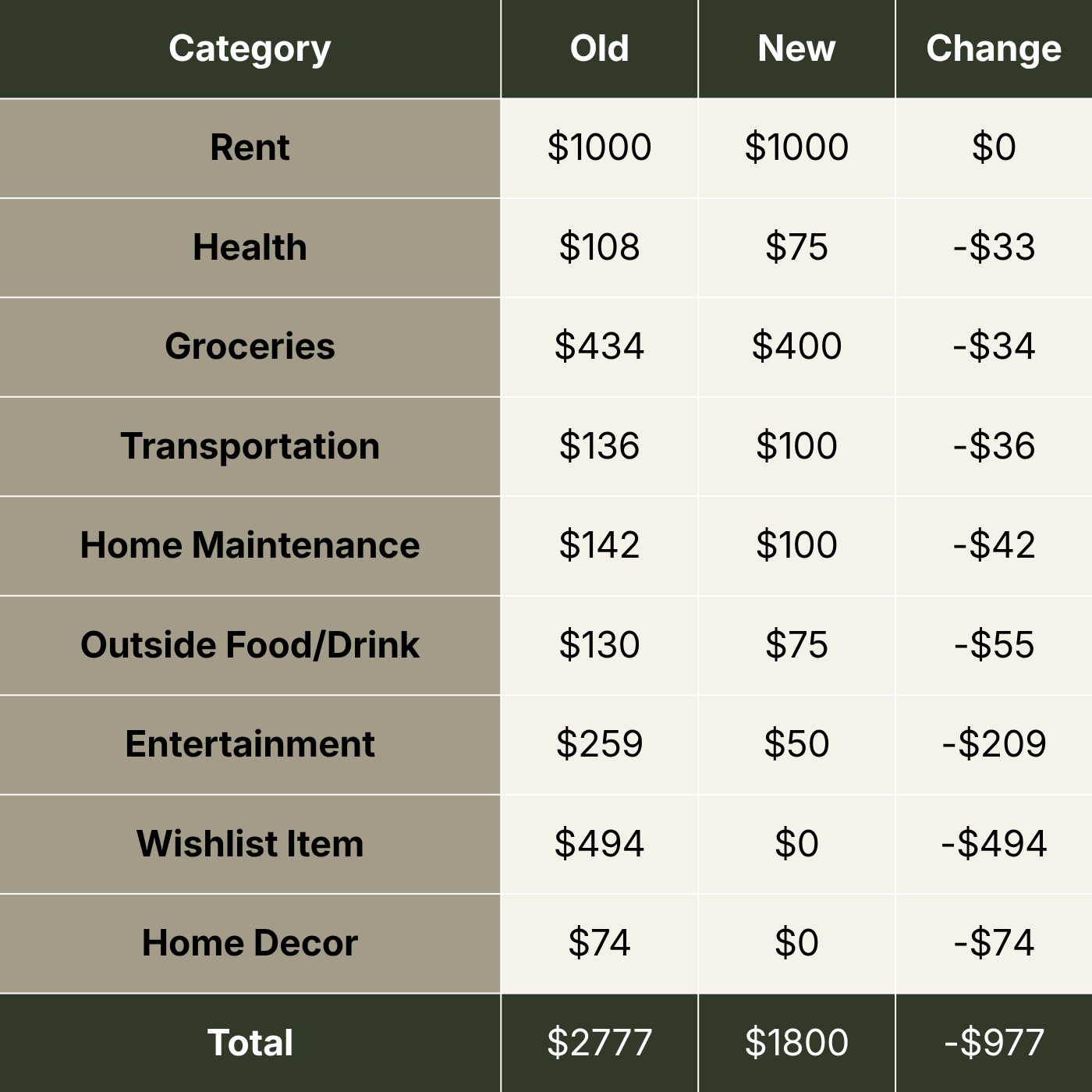
My average income for the past six months was $4,651, which made my average savings rate 40%. If I assume that my income stays relatively consistent (I work a 9-5 with side hustles that don’t vary in the extremes), then my savings rate will increase to 61%.

Saving tips for me (and you)
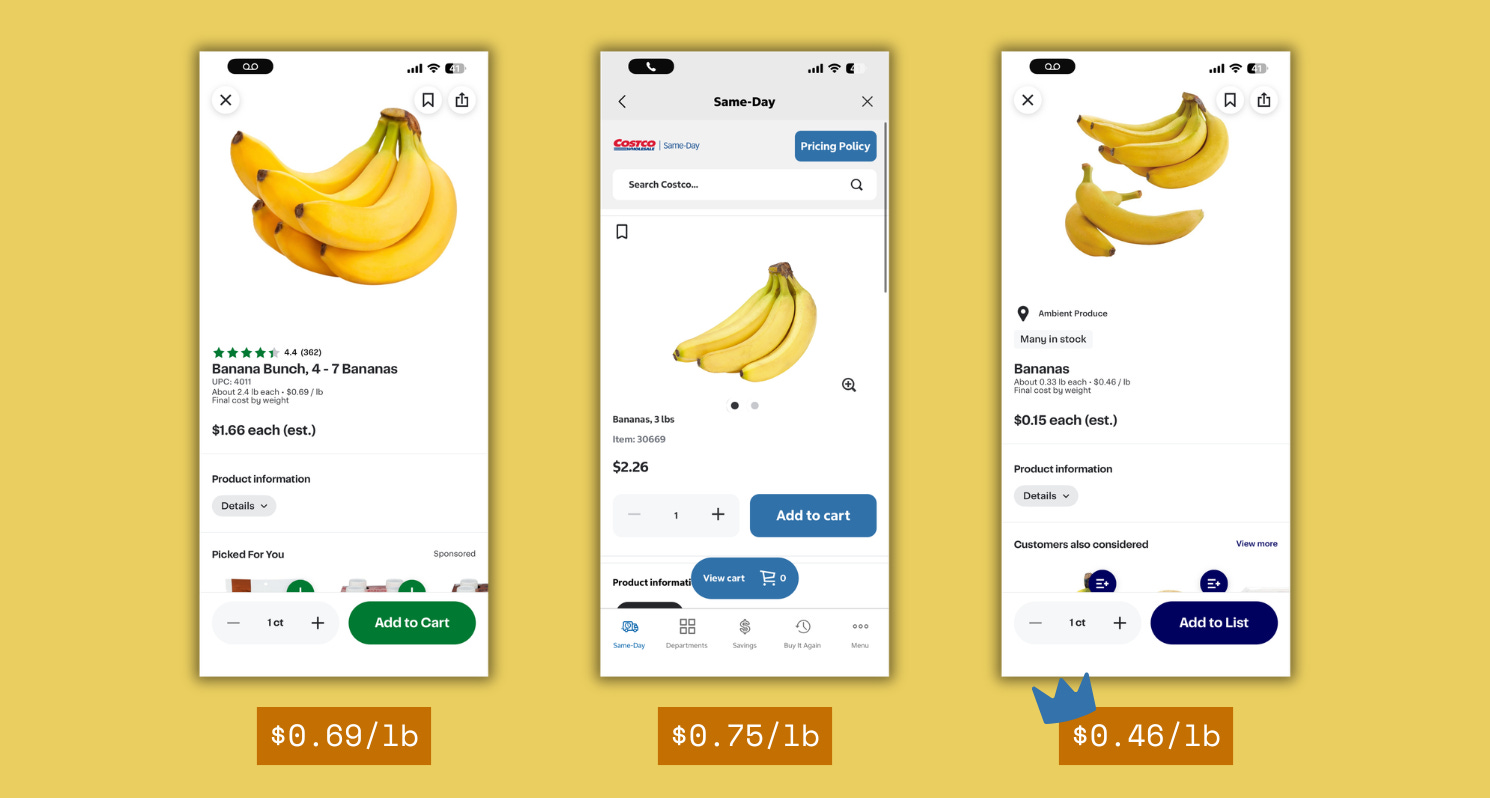
✶ Compare grocery store prices across the markets I frequent. I’m guilty of solely purchasing items from Sprouts despite knowing that it tends to be the most expensive option. Unfortunately, they sell most of my go-to’s, including my Oatly Barista Oat Milk, Purely Elizabeth granola, and Graza Original Mayo. With that being said, I can stick to my go-to brands from higher end stores, but as for produce, I need to opt for the cheapest.
✶ Eliminate first time, experimental grocery store items. For me, this pertains to fizzy drinks, convincingly effective supplements, or a crunchy savory snack using a niche ingredients. After trying Smart Sweets, I’m never touching candy marketed as “better for you”. I’m either consuming the full-bodied sugared up version, or none at all (the latter being the most realistic and healthy).
✶ Remove excess weight from my car. According to the U.S. Department of Energy, an extra 100 pounds in your vehicle could reduce your fuel economy by around 1%. The reduction is based on the percentage of extra weight relative to the vehicle’s weight and affects smaller vehicles more than larger ones. I have a foldable shopping cart that I no longer use, now that I live in an apartment complex without an elevator.
✶ Drive at the speed limit, and avoid rapid acceleration and braking. These days, I’ve found myself driving a bit more aggressively than I used to. Maybe it’s because the city I now live in has an influx of aggressively terrible drivers, and I feel the need to “match” that to get from Point A to Point B in a reasonable amount of time, also without being tailgated or cut off every five seconds. With increased patience, I’d like to pay more attention to how quickly I speed up and slow down, all while noticing my surroundings and keeping to my pace without feeling pressured to speed up because of an incessantly impatient knucklehead behind me.
✶ Emulate matcha and coffee shop drink recipes at home. Unfortunately, I will be removing a pop-up off my calendar because no matter how tempted their fig matcha latte, I have to pass for now. I also feel like some of these pop-ups are aesthetics-driven? I went to my first pop-up last year and ordered their strawberry matcha latte — truly one of the worst drinks I’ve ever had in my life. It was sour. Sour! Yes, strawberries are naturally sour, but that part of the strawberry flavor should not come through in a latte. (I tried making strawberry cheong 청 recently, and it is truly excellent. Dice some strawbs, do a 1:2 sugar to strawberry ratio mix, and set it in the fridge for a week. This + jasmine syrup is an unbeatable combo for matcha.)
✶ Ask before buying: If I didn’t know this existed, would I want this? Thanks Reddit, for this one! I like this tip a lot because it really shows how easily influenced we are by mass purveyors of social media. Even just taking a quick glance at my wishlist (referencing the screenshot in the above section), 90% of them are items I wouldn’t have ever known existed and I also wouldn’t have thought about wanting them. The air fryer and coffee syrups were wishlist items that sprung out of a random need while doing my day to day tasks. The rest were straight from social media.
✶ Avoid subscriptions that require additional purchasing of product. I’m thinking about the premium subscriptions to DoorDash, InstaCart, or Amazon Prime. You’re telling me I have to pay money in order to pay more money to get the things I want? I think not. Not having the subscriptions also prevents me from using these services to begin with. For a while, I was tempted to get InstaCart’s subscription because Costco is 20 minutes away and I hate the drive there, but I knocked some sense into my brain and did not pull through with that.
✶ Always ask for a price adjustment or if a fee can be waived. It never hurts to ask! From all the purchases I made in the last three months, all but one company agreed to waive their restocking/return fee, saving me at least $50. (The one that didn’t do it was Baboon to the Moon.) My email template is:
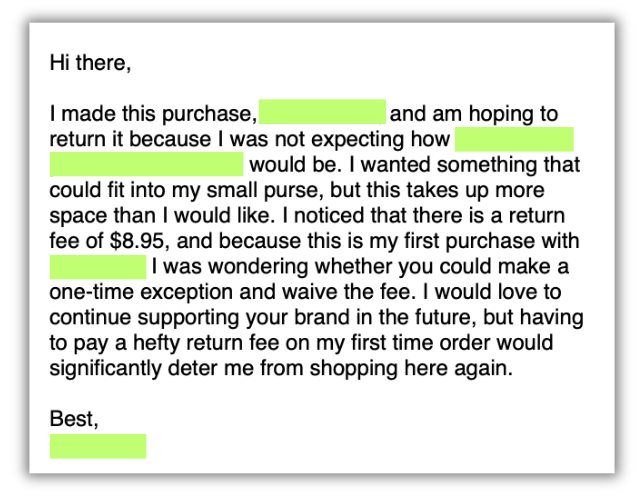
And their response was: I have confirmed that the fee will be waived. Please go ahead and use the return label we sent you to return the item. Once we receive the returned item, you will receive a full refund for the item or if you requested to have a exchange order, it will not include that fee.
I use a similar tone when I ask for discount adjustments as well. If an item goes on sale or the company has a store-wide discount shortly after I’ve purchased an item (I make sure to check that it is within the window frame of the return period as well to build my case), I email to see if they could honor the discount towards my purchase. I’ve received a lot of yeses and a few no’s (looking at you, Blueland).
✶ $1/use rule. Can you wear or actively use an item the number of times of it’s rounded up dollar value? Will your $180 dress yield 180 wears? I have a lot of regrets in this category, as I tend to buy exorbitantly priced, out of budget clothes that get worn, but not to the point where I could envision myself wearing it in the hundreds range. For example, I purchased a Gillian Stevens dress in 2025 for $224, and I’ve only worn it 24 times even though I feel like I’ve worn it 100. I wear it when I’m running errands and/or on my period, and I log my outfit daily. For all of that to only add up to 24 is insane, because Mr. Beans has jokingly commented on how I wear nothing but just that dress on weekends.
✶ Maintenance is cheaper than repair. Someone on Reddit said, “schedule your maintenance, or it will be scheduled for you.” 🤏🏻 And maintaining, no matter how tedious, terrible, exhausting, at times frustrating that the process may be, will always be less work than repairing. A few things to stay on top of include: car (taking it to the mechanic when any concerning light turns on); vacuum (cleaning the filter, removing hairs from the brush bar — disgusting but needed); getting an annual check paired with a blood draw (the first appointment is the most annoying to schedule, but once that’s done, everything else is on an automated schedule); using drain stoppers like a Tubshroom to catch hair and other gunk from going down the drain and clogging it (I’ll admit, I don’t do this because I’m in a rental unit but if I owned my own home, Draino is not allowed within premises); and cleaning and descaling your very expensive espresso machine.
✶ For toiletries, practice the one-in one-out rule by category. I’m pretty good at this for skincare and haircare, but I tend to get stumped with hand/body lotion. At this time, I have a full sized Prequel and La Roche Posay lotions on standby that I need to empty. Despite how badly I want to try the CYKLAR body lotion, I’m refraining from doing so until both bottles are cut in half and scraped out completely.
✶ Properly store produce in the fridge. Moldy vegetables and fruits are no stranger to me. Unfortunately, with rising produce costs, I can’t just bat an eye and do nothing. A brilliant person compiled this guide on produce storage tips.
✶ Only thrift cookware. Pots and pans should never be purchased at full price, specifically stainless steel and cast iron. My coworker, who is an avid cook (makes everything from scratch and I have never seen her eat out a single time at work — twins), only thrifts her kitchenware items. Luckily, we have a local nonprofit kitchen co-op that has a great, low-cost selection of kitchenware! I’ve also seen Goodwills around the world carry stainless steel. No matter what condition they are in, they can always be brought back to life.
✶ Use pre-made snacks only during emergencies. I’m fortunate as a baker to be able to see most baked goods (my weakness!) as a “I can make it better at home” reflexive thought. Unfortunately, savory chips are also my biggest vice, and I’ve never attempted (or wanted to attempt) making these at home. I will be omitting these from my diet and only buying individual packages for my car, purse, and work. I have hypoglycemia, so despite wanting to cut out snacks entirely, having them at arm’s reach can prevent me from fainting spells.
✶ Opt for powered cleaners over liquid or pods, as they are significantly cheaper. I currently use powder dishwasher detergent and it surprisingly cleans my dishes much more effectively than the Cascade pods I used to purchase. I’ve yet to switch from liquid to power for laundry, because I’m apprehensive about whether it’ll fully dissolve in the dispensing tray of my front-loading washer.
✶ No streaming services. I quit Disney/Hulu earlier this year, and for full transparency, I still use my parent’s Amazon account to watch shows/movies on Prime. If they stopped their subscription, I’d survive. These days, I only watch continuation of existing shows I know I love or book to film adaptations that I’m eagerly anticipating (e.g. The Love Hypothesis releasing September 23, 2026 — ahhh!). Try being ✨resourceful✨ if you really want to watch something.
✶ Check for credit card offers and google coupons prior to purchasing anything. On the Chase app, there is a “Chase Offers” section, and I always forget to check this prior to buying anything. I must have missed out on at least $50 this year by not doing this! Googling coupons is also handy thing. If there isn’t a newsletter discount code that the company offers, I’ll click through a few discount code websites and test out everything they say it’s active. Most of the time, it won’t work, but if I’m lucky, one will stick.
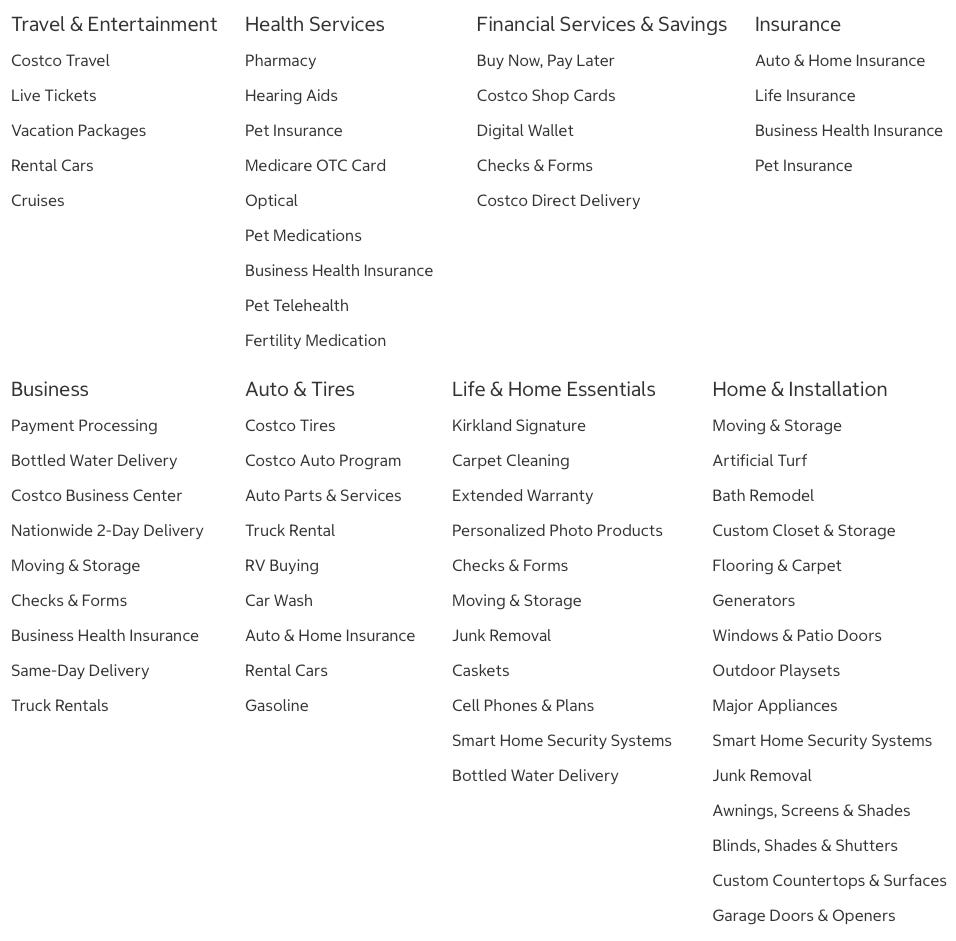
✶ Costco for everything. I am only a two year Costco-cardholder, and am still discovering how I could maximize benefit from my $65/year Gold Star membership. We recently booked flight and a hotel for our upcoming NYC trip, which is $2,100 per person. After a quick check on Costco Travel, a round trip flight + 4-star hotel stay is $1,620 per person; they also add a $150 Costco Shop Card as a perk. What. The. Heck. Our upcoming trip to Mexico City will absolutely involve Costco. Beyond travel, this is everything else they offer (with a few more in Home & Installation but I couldn’t fit it all into a screenshot).